
Editor’s Note:
Hello! Today’s guest post is brought to you by Ursula, a sloth bear who is determined to show, despite her species’ common name, that sloth bears have a lot of get-up-and-go. In that interest, she has learned to read and write.

“Greetings. Yes, I am a sloth bear, and yes, I wrote this myself, though the editor had to type it up for me because my claws are too long to make use of a keyboard.
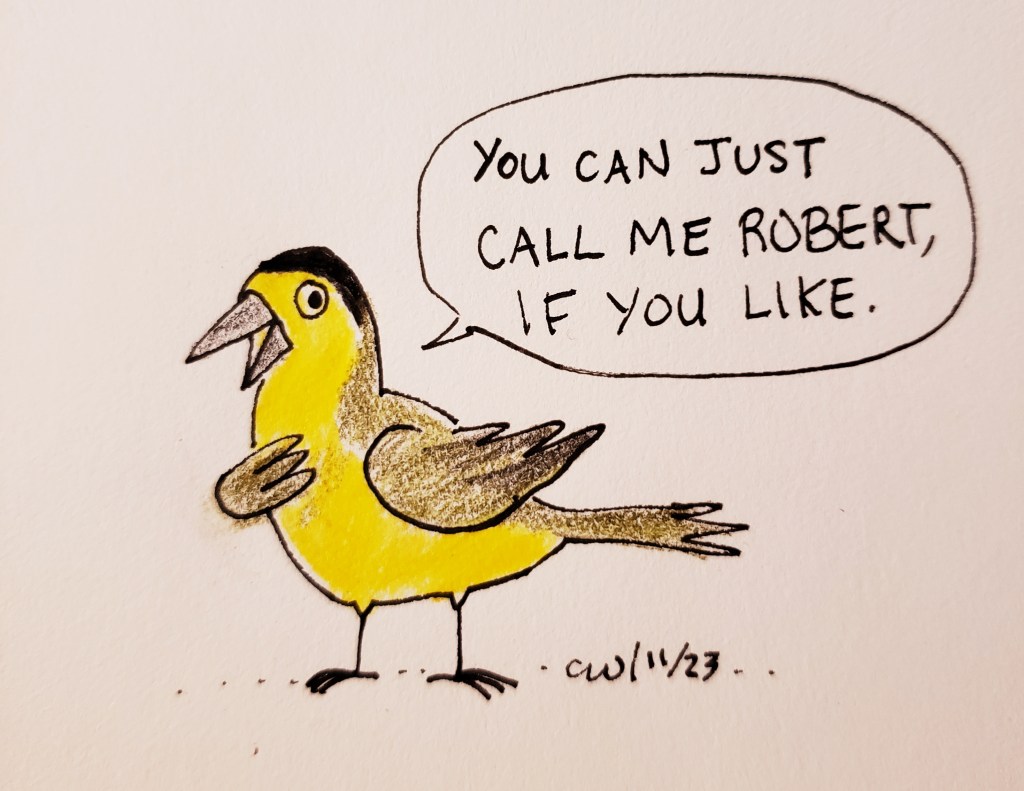
I am writing because even way off in my homeland on the continent of Asia, I have heard that many North American bird species will be getting new names. And this raised my hackles because I have long chafed at being called by my English-language name, ‘sloth bear.’
Sloth bear! As if! No offense to my fellow mammals, the sloths of Central and South America, who can’t help but move slowly and hang upside down from tree limbs. But I can run faster than one of you human beings if I’ve a mind to, and I am fully aware that you consider the trait of ‘sloth’ to be a deadly sin.
If you think I’m overreacting, listen to this. This is how I am described by a prominent geographical institute online: ‘Shaggy, dusty, and unkempt.’ (It also says I emit ‘noisy grunts and snorts.’ Can I help it if my snout is made for hoovering up termites and ants?)
Visit Wikipedia, and you’ll see me described again as having a coat that is ‘long, shaggy, and unkempt.’ (Again with the unkempt!) Plus it says that when I walk, my feet are set down ‘in a noisy, flapping motion’ and that I appear ‘slow and clumsy.’ Sheesh! (At least it acknowledges that I run and climb well.)
And a prominent zoological organization says that I am ‘a bit messy in appearance,’ as if I were a badly decorated cake being judged by Paul Hollywood on ‘The Great British Baking Show.’ It adds that my hair is ‘unruly.’ Well, I guess that’s a step up from ‘unkempt.’ But then it gets in one last dig by noting that my walk is ‘a bit awkward.’ Way to boost a bear’s self-confidence!
Just take a look at the other bears of the world and their glorious names.
Black bear? Totally sensible, even though they can also be brown or white. Brown bear? A-OK. Polar bear? Sure, why not, they live way up there around the northern pole. Moon bear and sun bear? Heavenly! Spectacled bear? Spectacles are pretty nifty. Panda? A name derived from a Nepalese name for “eater of bamboo.” (Well, it’s not snazzy, but it’s accurate—I dined out with a panda once, and believe you me, our choice of restaurants was pretty limited.)
You’ll notice none of those guys are named after an undesirable feature.
How did I get this undeserved name? It’s all because of this zoologist guy George Shaw who lived way back in the 1700s. He thought we bears were sloth-like because of our claws and our missing front teeth. So he called us bear-sloths. Which at some point got swapped around and became sloth bears. George, Pshaw!
So what would I like us to be called? Well, the Hindi word for ‘bear’ is ‘Bahlu,’ and I rather like that (and it would right the wrong done to my species in ‘The Jungle Book’ where a lumbering brown bear is usurping the spotlight from my kind of bear). But the scientific moniker you’ve given us, Melursus ursinus, basically means ‘honey bear,’ and I can totally live with that, especially if that honey’s got some termites in it.
OK, think about it, humans. Then you can get to work on the Dumb Gulper Shark and the Bone-eating Snot-flower Worm.
Yours truly,
Ursula ‘Way Too Busy to Be Slothful’ Bear”
 Christina Wilsdon